
Year after year, the same handful of mistakes sink thousands of UK learners on test…
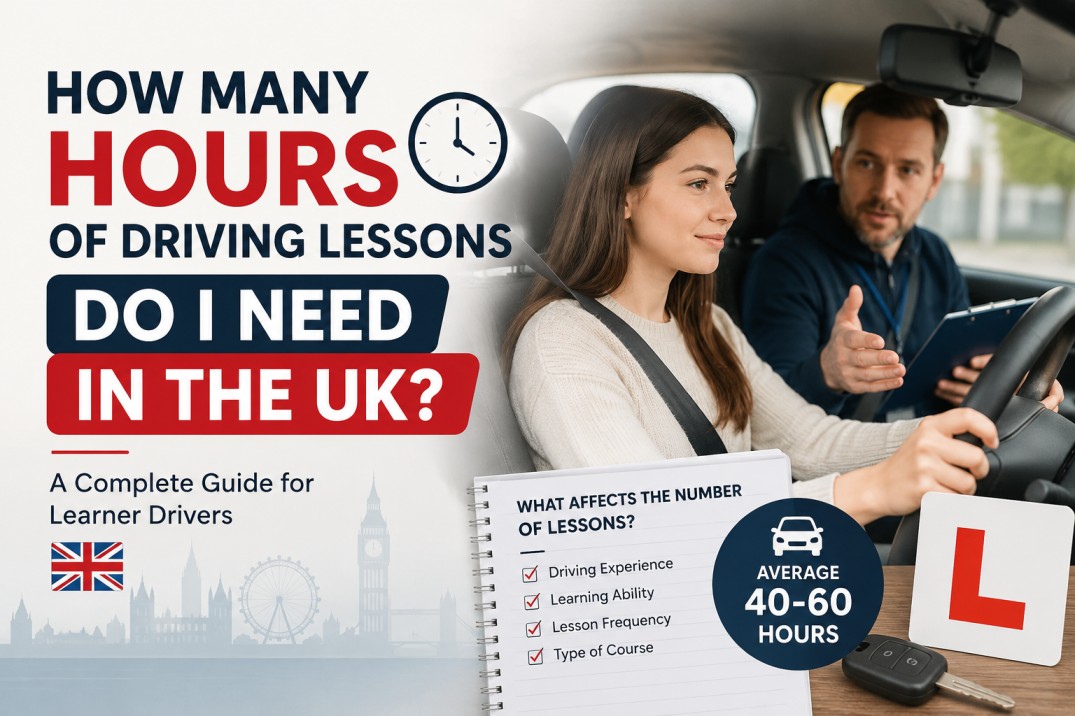
How Many Hours of Driving Lessons Do I Need in the UK?
Short answer: the DVSA’s own guidance points to around 45 hours of professional lessons plus roughly 22 hours of private practice for the average first-time pass.
There’s no legal minimum; you can book your test the moment you’ve passed theory, but most learners who try to cut that number short end up paying for it in retests.
Where Does the DVSA’s 45-Hour Guidance Figure Come From?
That 45-hour figure isn’t a rule anyone invented arbitrarily; it’s an average pulled from DVSA data on learners who passed first time, going back over a decade with barely any movement.
Add the roughly 22 hours of private practice on top, and you land somewhere near 65-67 hours total, combining paid instruction with supervised driving in a private car.
Worth repeating: this is an average, not a target. Some learners with prior exposure to cars, or a naturally quick feel for road awareness, pass comfortably on 25-30 hours.
Others need 60-plus, particularly if lessons are spread thin or gaps between sessions keep resetting progress. Treat 45 as a planning figure for your budget and timeline, not a finish line to race toward.
What Factors Affect How Many Driving Lessons You Need?
A handful of things push the total up or down more than people expect. Age is one; 17-year-olds often need more hours simply due to zero prior driving exposure, while returning adult learners sometimes need fewer.
Transmission matters too: automatic driving lessons typically need fewer hours than manual, since there’s no clutch coordination to bed in.
Lesson frequency counts for a lot as well. One lesson a week for 45 weeks is nearly a year of stop-start learning, while two 2-hour sessions weekly compress the same total into a couple of months and tend to need fewer overall hours, since skills don’t go stale between sessions.
If you’re weighing up frequency and pace, it’s worth chatting it through directly with an instructor via our book a driving lesson in Surbiton page before locking in a schedule.
| Learner Profile | Typical Professional Hours |
| 17-year-old, no prior driving | 45-55 |
| Adult learner, no family car access | 45-65 |
| Automatic transmission learners | 30-40 |
| Returning driver, lapsed licence | 15-25 |
| Overseas licence, converting to UK | 10-20 |
How Many Hours of Private Practice Does DVSA Guidance Recommend?
The 45-hour DVSA figure sits alongside an assumed 20-22 hours of private practice, and that second number does real work.
Learners who combine paid lessons with regular private driving are meaningfully more likely to pass first time, since practice consolidates whatever the instructor covered that week rather than letting it fade before the next session.
Private practice does need proper cover though: a supervising driver who meets DVSA requirements and short-term learner insurance to protect the car owner’s no-claims bonus.
If access to a car is the sticking point, it’s worth leaning a bit more heavily on structured driving lessons instead, since that’s the part entirely within your control.
Is an Intensive Driving Course Better Than Spreading Lessons Out?
An intensive course packs a similar total number of hours into days rather than months, and some learners genuinely do better this way, since everything stays fresh rather than half-forgotten between weekly sessions. It’s not a shortcut on total hours, though; you’re still doing the work, just compressed.
Spreading lessons out over a longer stretch suits people juggling work, school, or a tighter weekly budget, and there’s nothing wrong with going slower provided sessions don’t drift too far apart.
The main risk with a stretched-out schedule is momentum; skills learned six weeks ago need re-covering if there’s been a long gap, which quietly adds hours back onto the total.
FAQS
Is there a legal minimum number of driving lessons in the UK?
No. You can book your practical test as soon as you’ve passed theory, regardless of hours completed. What matters is whether you can drive safely and independently for the test duration.
Can I pass with fewer than 30 hours?
Yes, particularly with prior driving exposure or a naturally quick grasp of road awareness, but it’s not typical.
Do automatic learners need fewer lessons than manual?
Generally yes, often by around 10-15 hours, since there’s no clutch control or gear coordination to master.
Is an intensive course actually faster overall?
It compresses the calendar, not necessarily the total hours; you’re usually still completing a similar number of lessons, just closer together.
How many lessons per week is ideal?
Two lessons of 1-2 hours each tend to work better than one, since it keeps skills fresh without losing momentum between sessions.
Related Posts
Comments (0)